Shockwave Parts
Shock Pump Needle Adapter | IFP & Bladder Pressurization
Shock Pump Needle Adapter | IFP & Bladder Pressurization
Couldn't load pickup availability
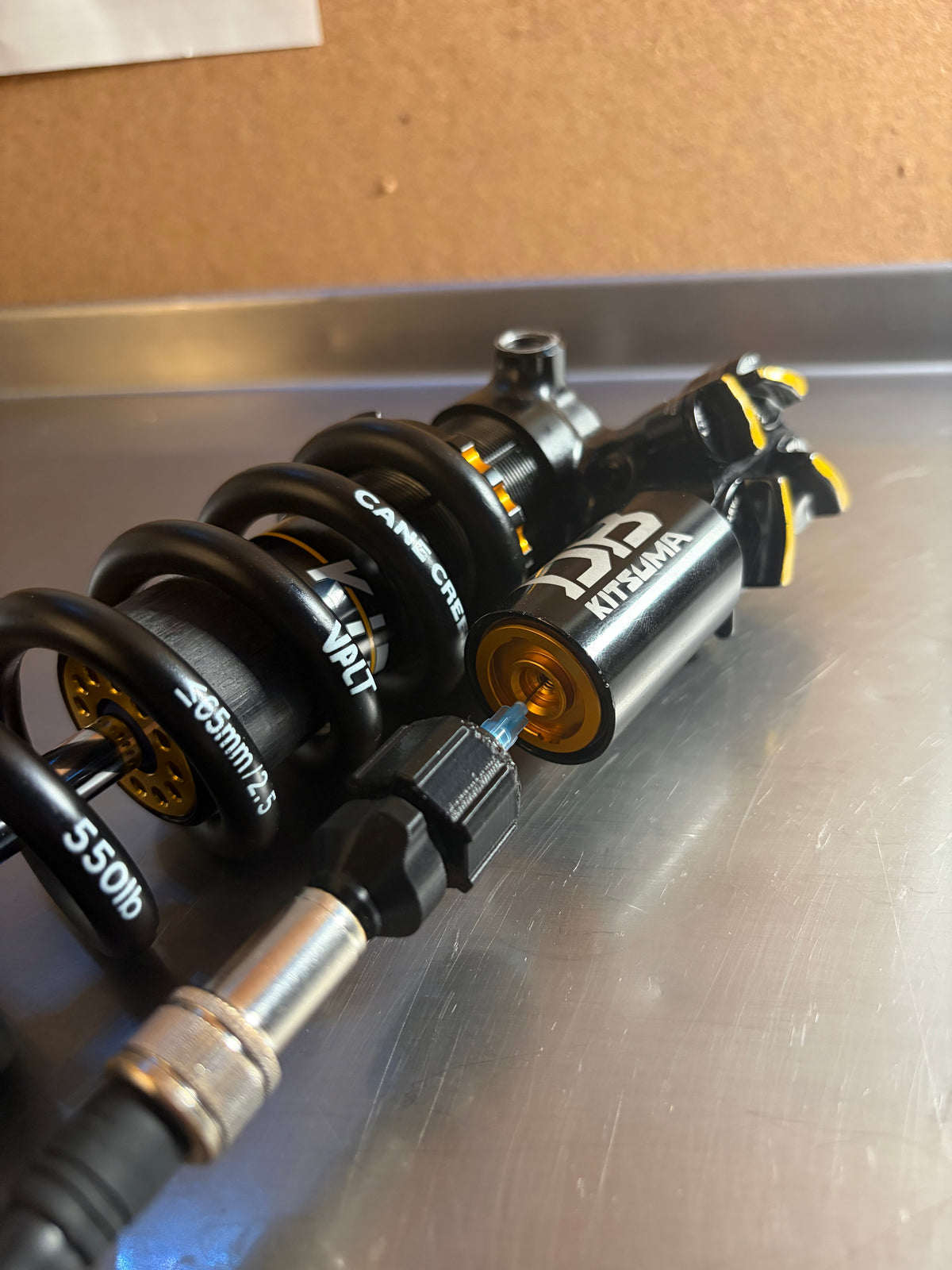
Lightweight needle fill tool for charging the IFP / bladder chamber through the rubber plug / pellet. Available in a Deluxe version with stainless steel shock pump threads and a Home Mechanic (Lite) version.
It runs off the shock pump you already own. The same pump you use to set up your fork threads right onto this tool. No nitrogen tank, no regulator, no complicated setup: this is essentially a shock pump adapter for needle filling.
⚠️ Releasing pressure? Disconnect the shock pump first
The tool ships with no Schrader valve core, on purpose, so it never traps pressure.
Filling is simple: the pressure climbs gradually and you control it. Going into a chamber that already holds pressure is the one case to watch. With the pump disconnected, that pressure vents harmlessly out the open end. With the pump attached it has nowhere to go, and the tool can see the full chamber pressure at once, past its rating.
So release pressure with the pump disconnected, or with a bare needle. And never connect the tool to a chamber above its rating.
Deluxe vs. Home Mechanic (Lite)
The difference is in the fittings.
On the Deluxe version, the Schrader threads where the shock pump connects are stainless steel. That is the connection you make and break most often, so it is the one that benefits from metal.
The Home Mechanic (Lite) version uses printed threads instead of metal. It works just as well, but the printed threads will show more wear over a long period of repeated use, so it is meant for less frequent servicing.
The Lite is rated to 200 PSI rather than 300, and it seals a little less tightly than the Deluxe. Not by much, but you will see the gauge creep down slowly. The trick is to pump quickly and go slightly above the pressure you want, then pull the needle out as the gauge passes your target.
The Lite threads should get you through 10+ rebuilds easily. On a tester I threaded and unthreaded the fitting 20+ times and it still worked fine. In practice, how you store and handle the tool matters more than the number of rebuilds you do with it.
Neither version is a shop tool. The Deluxe version is intended for home-mechanic use and occasional-to-regular servicing. If you are rebuilding 170 shocks a season in a professional suspension shop, this is not the tool for that job.
Compatible with
- FOX
- Vorsprung
- Öhlins
- X-Fusion
- Cane Creek
- Most other shocks with a rubber plug / pellet in the IFP or bladder chamber
Connects to any shock pump or filling tool with a standard Schrader thread, including the regular shock pump you already use for your fork. No nitrogen setup required.
Uses standard 23 gauge hypodermic needles. Luer lock needles are not used.
What's included
- The needle fill tool, in your chosen version
- Canadian orders: 3 x 23 gauge needles
Orders outside Canada do not include needles. Shipping needles internationally is complicated.
It is not much of a loss: 23 gauge needles are cheap and sold nearly everywhere. See the needles section below for what to look for.
Pressure rating and testing
The Deluxe version is rated to a maximum of 300 PSI. The Home Mechanic (Lite) version is rated to a maximum of 200 PSI.
Both have been pressure-vessel tested at 300 PSI, with 20 pressure tests per fitting across the different versions.
Most suspension shocks run at around 200 PSI or less, which is what both versions are built around.
Do not exceed the rating for your version, and never exceed 300 PSI. In particular, do not use this tool at 500 PSI on high-pressure inline shocks. For pressures that high, use a professionally rated tool designed for them.
Light enough that the needle stays straight
22 grams with a needle installed. The metal tool I was using before weighs 50 grams, and it uses long proprietary needles that bend just about every time. This one is shorter and uses as few metal parts as possible, so there is barely any weight hanging off the needle and it stays straight while you work. It makes the whole job a lot easier.
The fittings are large and robust, so you do not need to crank down on the connections. Tighten the needle a little, and the same for the shock pump connection. At normal operating pressures they seal without excessive force.
And despite being far lighter, it lands at roughly the same price as the alternatives.
Needles you'll need
Both versions use standard 23 gauge hypodermic needles. They do not use Luer lock needles.
Go with the 25 mm (1 inch) length. It is the shorter of the two common sizes, and the short length is what keeps the needle stiff. 35 mm needles are also out there, but they are a bit long for this and bend more easily.
Because these are standardized medical needles, they are cheap and easy to find in most countries. Compare that to the proprietary needles on some metal tools, which run around $20 for two and cannot be swapped for medical needles.
Here is an example of needles that work: 23 gauge, 25 mm needles on Amazon Canada.
Because the needle is a consumable, you can swap in a fresh one whenever the tip dulls instead of replacing the tool.
How to use
- Fit a fresh needle, tightening it only a little
- Thread the tool onto your shock pump or filling tool
- Insert the needle into the centre of the pellet while rotating it gently, never forcing it
- Inflate slowly to your target pressure, staying within your version's rating
- Pull the needle out quickly and immediately snug the pellet
- Cycle the shaft to confirm it returns smoothly
On the Lite version, pump quickly. It leaks slightly, so go a bit past the pressure you want and pull the needle as the gauge comes back through your target. Trying to sit exactly on the number and then pull is what makes it fiddly.
Do not overtighten the needle. A little is enough for a good seal. If you crank it down hard, the male slip fitting can bend slightly when you pull the needle back off. If you see a leak, snug it a bit more, but you should never need much.
Never bend the needle. Rotating gently on the way in is what keeps the tip straight and the pellet undamaged.
New to needle filling? Read our full guide: How to pressurize or depressurize a damper using a needle fill tool. It covers depressurizing, pellet retainers, pellet torque, and why you don't actually need nitrogen.
How it's made
Making a fully 3D printed version of this tool was not simple. It took very precise tolerances, a lot of experimentation, and a printing technique developed specifically to keep pressure from getting inside the printed part.
The result comes out of years of working with Shockwave parts and pushing at the limits of what 3D printing can actually hold.
⚠️ Disclaimer
This tool is intended for riders performing damper service where the IFP or bladder chamber needs to be recharged.
Deluxe: 300 PSI maximum. Home Mechanic (Lite): 200 PSI maximum. Do not exceed the rating for your version. We cannot guarantee the tool will not fail or cause injury if it is operated beyond its rating.
To release pressure from a shock, do it with the shock pump disconnected, or with a bare needle on its own. Going into an already-pressurized chamber with the pump attached transfers the full chamber pressure into a closed tool instantly. The tool ships with no Schrader valve core so that pressure can vent instead of building up.
Needles are sharp and the chamber is pressurized. Wear eye protection and handle needles carefully. Dispose of used needles in a sharps container or through a pharmacy or drugstore needle disposal program. Options vary by location, and you should not assume a local bike shop accepts used needles unless they have confirmed that they do.
Home-mechanic tool only. Strong and precise, but not designed for shop-level volume use. By purchasing or using this tool, you agree to our Terms of Service.
Share